In municipal water and wastewater systems, problems rarely respect property lines. Grease discharged from a private development can cripple a city lift station. Aging pipes beneath a school or hospital campus can back up into a municipal collection system. And stormwater infrastructure installed decades ago on private property can quietly undermine public assets downstream.
For James Terry, founder and CEO of Green Team Building Services, this blurred boundary between public and private infrastructure has defined the way his company has grown and why it now operates comfortably in both municipal and institutional environments across South Florida.
Founded during the depths of the Great Recession, Green Team did not begin as a municipal contractor. It began as a one‑man plumbing operation built out of necessity. Over time, driven by customer demand, equipment investment and a relentless focus on efficiency, the company evolved into a multidiscipline underground services provider capable of cleaning, inspecting, repairing and rehabilitating sewer and stormwater systems that ultimately feed into municipal networks.
Today, Green Team supports cities, school districts, utilities and large institutional property owners throughout Florida often stepping in where private infrastructure directly affects public systems.

Green Team Building Services members Manadou Blase (left) and Shane Baker open up a storm drain in Fort Lauderdale.
Born in a recession
Terry’s entry into contracting was neither planned nor romanticized. In 2009, he was a third‑year plumbing apprentice working for a family‑owned company when the recession abruptly ended his employment and his housing.
“I got handed my last paycheck, and I also got told I needed to get out of the house I was renting,” Terry recalls. With few companies hiring and no clear safety net, he searched for options and found unexpected consensus: Starting a business during a recession could level the playing field.
At 24, Terry began taking side jobs such as faucet repairs, small plumbing calls, barter work, essentially anything that would generate income. What began as survival quickly turned into momentum. While still in his apprenticeship program, Terry earned perfect attendance recognition, catching the attention of experienced contractors who became informal mentors.
One of those early opportunities came from health care facilities. Mechanical contractors often avoided plumbing repairs inside hospitals, opening a door for Terry to step in. That work expanded into schools and other large facilities, laying the groundwork for what would eventually become Green Team Building Services.
 James Terry is the founder and CEO of Florida-based Green Team Building Services.
Geography and growth
Green Team’s core service area stretches across South Florida from Broward, Miami‑Dade and Palm Beach counties north through Orlando and the Space Coast, with additional work in Tampa and other regions as large clients require.
“We go where the customer tells us to go,” Terry says, noting statewide service for large distribution and industrial clients. That geographic flexibility has also supported municipal and institutional projects that fall outside traditional city boundaries but still connect directly to public systems.
Green Team’s transition from plumbing into underground utility work was not driven by marketing or a strategic plan. It came from customers asking a simple question: What about the pipes outside the building?
Parking lots, private roadways and campuses contain extensive sewer and stormwater infrastructure, often larger in diameter and older than building plumbing. Initially, Green Team subcontracted that work. Over time, service inconsistencies and missed emergency response windows pushed Terry toward a pivotal decision.
A severe storm and a subcontractor who could not respond convinced Terry to invest in his first vacuum truck, a 2019 Vactor 2100 Plus. He then stepped away from managing the company to learn the truck firsthand, operating it himself for six months.
“That was the only way to understand the business, the equipment and the risks,” Terry says. Once trained, he transitioned operations to a dedicated department leader and began expanding capabilities.
That first truck opened the door to municipal bidding, but it also revealed a limitation: cleaning alone was not enough. “Vac trucks clean and jet,” Terry explains. “They don’t inspect.”
Customers wanted to know what their pipes looked like after cleaning, particularly when sinkholes, collapses or chronic backups appeared. The answer was CCTV.
 Shane Baker cleans a storm drain in a Fort Lauderdale business complex.
Full‑service model
Green Team’s underground services evolved into a three‑tiered approach:
- Cleaning and jetting of sewer and stormwater lines and structures
- CCTV inspection to assess condition and diagnose failures
- Targeted repairs or rehabilitation, ranging from point repairs to full CIPP lining
This model allowed the company to address problems end to end without handing customers off to multiple contractors. “If we can’t see the pipe, we can’t propose a real solution,” Terry says. “And if we inspect it and find damage, someone has to fix it.”
In South Florida, Green Team found a niche in smaller‑scale repairs in the range of $5,000 to $20,000 that many large contractors avoid. These projects are common on institutional campuses and private properties, but can have big impacts on municipal systems.
Capabilities now include:
- Vacuum excavation and hydroexcavation
- CCTV inspection and mapping
- Sliplining for corrugated metal storm drains
- Point repairs
- CIPP lining using UV‑cured blue‑light technology
- Select opencut replacement when required
Green Team currently utilizes HammerHead Trenchless products for UV‑cured lining, allowing rehabilitation of buried assets where excavation would disrupt operations or public access.
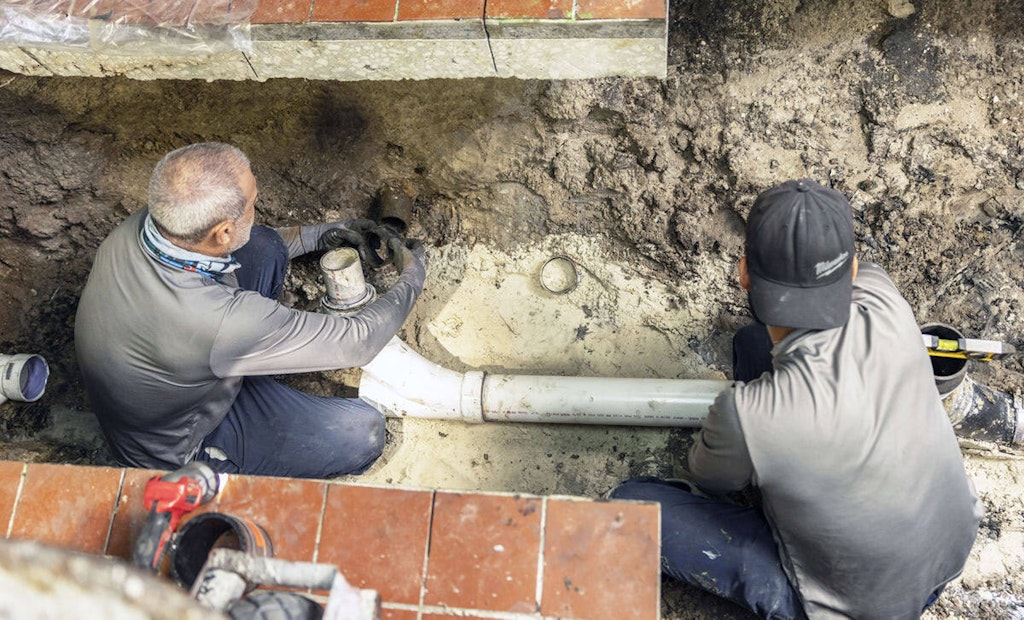
 Green Team Building Services crew member Adrian Georgescu works to repair a damaged pipe.
Flowing downstream
While much of Green Team’s work occurs on privately owned property, Terry is careful to distinguish institutional infrastructure from small commercial plumbing.
Universities, hospitals, corporate campuses and mixed‑use developments often function like self‑contained cities. They contain miles of sewer and storm piping, lift stations and complex drainage networks. While stormwater is typically managed onsite, sanitary sewer almost always ties into municipal collection systems. “What happens on private property doesn’t stay there,” Terry says. “If it backs up or fails, it affects the city downstream.”
One example involved a large mixed‑use retail development where grease was repeatedly clogging a municipal lift station. Though Green Team was hired by the private property owner, the issue originated from illegal grease trap connections tied into sanitary lines.
Green Team mapped the entire underground system, dye‑tested restaurant connections and traced the problem back to specific cross connections. Correcting the private‑side infrastructure protected municipal pumps not designed to handle grease solids, resolving a problem that had become a recurring burden for the city.
“That’s where wearing two hats matters,” Terry says. “You’re solving a private problem that’s causing a public failure.”
Handling logistics
Green Team’s experience in institutional environments has translated directly into municipal‑scale execution, particularly where access, scheduling and logistics are constrained.
One such project involved a public high school where approximately 400 linear feet of public sewer main ran beneath a primary interior hallway. All work had to be completed during a two‑week winter break.
The scope included concrete cutting and excavation, hydroexcavation, opencut replacement, trenchless repairs, jetting and reinstatements, and tie‑ins back to the sewer main.
The building needed to reopen fully accessible when students returned. “That project had no flexibility,” Terry says. “It had to be done completely before school resumed.” Projects like this, he notes, mirror larger-scale municipal work in every respect: schedule pressure, public safety concerns, coordination with utilities and absolute deadlines.

Controlled risk
Across all markets, Terry’s operating philosophy centers on efficiency, driven by data rather than instinct. “Data drives decisions,” he says. “You don’t buy another truck because you want one. You buy it because the backlog, utilization and cash flow say it’s time.”
That discipline is critical in a capital‑intensive business where vacuum trucks, CCTV systems and trenchless equipment carry high acquisition and maintenance costs. Seasonal demand, particularly in Florida, adds another layer of complexity.
Municipal work helps balance that seasonality, but Terry is candid about the challenges of low‑bid procurement. “There are companies that win by being the cheapest,” he says. “But if you don’t invest in people, training and culture, that model eventually breaks.”

Crew and culture
Green Team employs approximately 50 people. Rather than focusing solely on credentials, Terry prioritizes work ethic and attitude. “We can train technology. We can train in confined space. What we can’t train is work ethic,” he says.
The company emphasizes communication, preparation and support, from digital mapping that crews can access before arriving onsite to practical shop amenities that recognize the realities of fieldwork in South Florida’s climate. The goal, Terry says, is simple: Treat people well so they treat customers and public assets with the same care.
For Terry, culture is not a soft concept, it is a form of risk management. Green Team emphasizes preparation, communication and accountability, recognizing that underground work leaves little margin for error. Crews are equipped with digital maps, job-specific information and clear expectations before arriving onsite. The company’s internal systems are designed to reduce surprises — not eliminate them, but manage them. “Mistakes happen,” Terry says. “What matters is how fast you recognize them and how you respond.”
Hybrid role
As cities across Florida contend with aging infrastructure, increased storm intensity and expanding development, Terry sees a growing share of municipal risk originating outside city-owned rights-of-way.
Private campuses, mixed-use developments and institutional properties often contain decades-old sewer and stormwater systems that were never designed for today’s flows or regulatory expectations. When those systems fail, municipal utilities are frequently left to respond.
“Cities end up dealing with the consequences even when the pipe isn’t theirs,” Terry says. “A lift station doesn’t care where the grease came from. It just knows it’s failing.”
This dynamic has increasingly placed Green Team in a hybrid role of working for private owners while coordinating closely with municipal utilities to diagnose and resolve problems before they escalate into systemwide failures.
Early diagnosis
One of the most valuable services Green Team provides to municipalities is not excavation or lining, it is diagnosis. On large institutional and mixed-use sites, original as-built drawings are often incomplete or inaccurate. Renovations layered over decades further complicate underground layouts, leaving utilities blind to what is actually happening beneath the surface.
In those situations, Green Team deploys a combination of CCTV inspection, mapping and dye-testing to reconstruct underground systems in real time. “We’ll map everything,” Terry explains. “Every structure, every line, every connection. Once you know where things actually go, the problem usually becomes obvious.”
That investigative work has helped municipalities trace sources of inflow, grease and cross connections that were damaging public assets downstream. Rather than repeatedly repairing pumps or responding to backups, utilities are able to address root causes often on the private side with data to support enforcement or corrective action.

Defining characteristics
Municipal and institutional projects share a defining characteristic: zero tolerance for disruption. Work often must be performed overnight, during school breaks or within narrow shutdown windows to avoid public impact. Terry notes that this environment rewards contractors who can self-perform multiple scopes without relying on layered subcontractors.
Green Team’s ability to combine hydroexcavation, trenchless repair, CCTV inspection and limited opencut replacement allows crews to adapt in real time when conditions change. “In underground work, something unexpected always shows up,” Terry says. “If you can’t pivot, you’re stuck.”
That flexibility has proven critical on projects involving schools, universities and public facilities where deadlines are immovable and access is restricted.
While Green Team does not rely exclusively on municipal contracts, Terry views public work as an important stabilizer particularly during seasonal slowdowns in private development. At the same time, he is candid about the challenges of low-bid procurement. “Price matters, but qualifications matter more when things go wrong,” he says. “Unfortunately, the system doesn’t always reward that.”
Terry believes municipalities benefit when contractors bring experience from both sides of the public-private divide. Exposure to institutional environments where downtime, liability and public visibility are high, builds habits that translate directly to municipal reliability.
Seeing all sides
As Florida’s infrastructure continues to age, the intersection between private, institutional and municipal systems will only grow more complex. Terry believes contractors who understand all sides of that equation will be best positioned to help utilities protect their assets.
“Municipal systems don’t exist in isolation,” he says. “They’re connected to everything upstream. If you ignore that, you’re always reacting instead of preventing problems.”
For Green Team Building Services, an understanding that was forged in recession, refined through equipment investment and proven in the field has become both a differentiator and a responsibility.