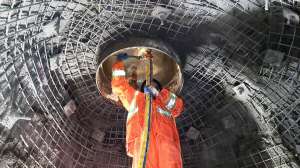
Two-hundred-sixty feet below the surface of Lake Ontario, crews worked day and night to expand Toronto’s wastewater treatment capacity. The Ashbridges Bay Treatment Plant Outfall project, part of the largest and most significant stormwater management program in the city’s history, sought to create a new fallout and watertight shaft to replace the existing 80-year-old system.
The project required extensive underground tunneling with an 11,500-foot tunnel and 50 connected risers. The contract for the tunneling and concrete work was awarded to Southland Mole of Canada and Astaldi Canada Design and Construction Joint Venture. Southland Mole of Canada, an excavation company specializing in trenchless technologies and difficult tunneling configurations, joined the project to create the tunnel and break through the lakebed to the risers above. For such a complex project, they needed hard-hitting, durable machines that didn’t require operators to stand in the danger zone.
Historic project
The city of Toronto embarked on the largest and most significant water quality improvement project in its history in 2020. The project was designed to address shortcomings in the Ashbridges Bay Treatment Plant, the largest wastewater treatment facility in the city, as well as one of the oldest. Its outfall was where treated water from the city’s sewer system was released and dispersed into Lake Ontario.
The Ashbridges Bay Treatment Plant Outfall Project was constructed with an estimated $300 million budget as part of the five-year project to improve the city’s shorelines, beaches and Lake Ontario’s water quality. The new outfall required creating a new 52.5-foot-diameter onshore shaft to a depth of 279 feet where it connects to an 11,500-foot long tunnel with an internal diameter of 13.1 feet. The project also involved excavating through the floor of the lake to locate 50 preinstalled risers, which convey treated and disinfected effluent from the city of Toronto’s Ashbridges Bay Treatment Plant into Lake Ontario.
All effluent flows from the plant are now directed through the new outfall up to the wet weather design capacity of 264,120 gpd. With only 3.3 feet of hydraulic head available at peak design flows under the highest recorded lake water level conditions, the outfall components were designed to minimize headlosses and allow the outfall to operate by gravity.
Southland Mole began work on the project in 2020, using a tunnel boring machine to mine the shaft. At the same time, another team on a barge positioned the risers and inserted them into the lakebed of Lake Ontario.
“The point of the project is to convey the treated wastewater, which has been processed through the wastewater treatment plant, back into the lake,” says Kevin Collins, equipment manager with Southland Mole. “Barges prepositioned the risers, so we just had to locate them by drilling up into the rock. Although the project is straightforward, it is not simple.”
Connecting the risers to the tunneling system became the most intricate aspect of the project. The Southland Mole crew had to excavate upward through the new tunnel into the lakebed above to link the risers to the tunneling system. This necessitated forward thinking and careful consideration of equipment.

The right machines
Collins and his crew needed to dig straight upward into the lakebed to locate the risers positioned 5 to 10 feet above. The team on the barge used GPS to locate each riser, but the location wasn’t exact. This meant they needed to excavate more material than strictly necessary to find the risers. As the team worked, debris and water would fall directly onto any machine being used as well as the operator inside the cab. Southland Mole’s team knew they needed a unique machine that could withstand the harsh working conditions.
The solution required enough hitting power to break through the concrete shell of the tunnel and into the Georgian Bay shale without succumbing to the pressure. They also required more precision. The risers were full of water and featured 2-inch valves at the bottom of the pipe. Breaking the valve would result in a deluge of water falling into the tunnel. This not only endangered the machine, but also the operators. Fine control of the machine was crucial to guard against these dangers.
At the beginning of the project, they attempted to use a large piece of equipment. However, while the larger machine broke the concrete, they found that it lacked consistency and accuracy. It was also too large to perform trimming. Fine trimming required workers to use pneumatics, rivet busters or chippers to break down the edges of the material.
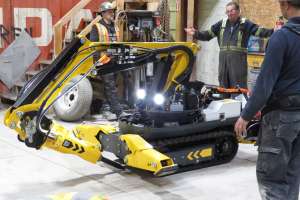
In the past, Southland Mole used Brokk remote-controlled demolition robots for tunneling, so they knew the benefits of the compact yet powerful machines. They understood that, given the type of work they would be undertaking in the outfall project, they would need a smaller, more compact piece of equipment. That’s why they decided on a Brokk 120DII armed with a Breaker 155 attachment. The Brokk 120DII comes in a compact size of 2.5 feet wide, 6.5 feet long and 4 feet high, weighing about 2,700 pounds. Powered by a compact and efficient diesel engine, the Brokk 120DII can run a full shift independent from any power source. The diesel engine features a Tier 4 emissions control system, making it safe to operate underground.
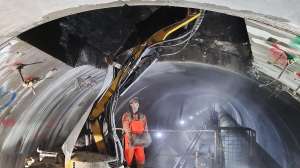
Excavating up to the risers required extensive overhead work. The Brokk 120DII boasts a vertical reach of 14 feet with the breaker attachment. Collins and his crew commissioned three outfall riser gantry platforms for the project. The first platform was manufactured to raise and lower with the Brokk 120DII loaded onto it, while the second and third platforms were only rated to transport personnel and equipment. The platform stands at 5 feet and can be raised up to 7 feet, positioning the Brokk 120DII and crew members anywhere from 5 to 10 feet above the tunnel surface. The arm of the Brokk extended up to break through the concrete and into the lakebed above, primarily composed of Georgian Bay shale.
However, the size of the shale wasn’t consistent. The way the shale layered, when it broke off, it would fall and break on top of the Brokk robot. So, the machine regularly battled falling rock and water while working up toward the risers. The crew ended up renting two Brokk 120DIIs. With the extreme conditions the machines were subjected to every day, the team had to stay on top of maintenance, which required Collins and his crew to work closely with Brokk’s team.
“We underestimated where Southland Mole’s team needed to position the machines,” says Mike Martin, vice president of operations for Brokk. “They were directly in the line of fire when it came to the debris field, both for the shale and for falling water, and the arm was fully extended upward. We knew the machines would take a beating for this application. But it got to the point where we needed to send another machine up there as backup to ensure nonstop service.”
The Brokk team sent a Brokk 110 to the Ashbridges Bay Treatment Plant to ensure they could continue to work at full capacity. However, since only one machine needed to operate at a time, when a Brokk 120DII required downtime for maintenance, the other worked.
“No matter what conditions our equipment is working in, we do everything we can to get the job done,” Martin says. “We always work to provide our best people and our best equipment no matter the application. And that’s the attitude we took when working with Southland Mole. Whether it was spare parts, inventory, extra hammers or something else, we gave everything we could to get this very difficult job completed. It’s really a testament to the Brokk itself, and how willing Southland Mole was to work with us to keep these machines working.”
Out of danger
Thankfully, the Brokk team got parts and equipment to the work site in time to keep both machines up and running despite the demanding conditions.
“The Brokk robots were really the only equipment option to get this type of work done. To achieve the same power, we would have needed bigger machines that didn’t fit in the tunnel as well, and then we’d require handwork, which put our crew in the danger zone,” Collins says. “We would much rather have the machine itself be at risk than risking one of our crew members. While the machines took a beating from the shale and water, it was much safer and much more productive than any other option.”
The Southland Mole crew worked 24-hour days with 20 workers per 12-hour shift. The first platform that supported the Brokk carried three crew members with a second and third platform following behind. The second platform carried the crew that completed rock bolts and mesh, while the third platform applied shotcrete to the mesh and rock before sealing the surface.
To find all the risers and complete this portion of the project, the crew worked for a little over six months.