
Even by Canadian standards, Rankin Inlet is cold. That poses plenty of challenges for those operating the water and wastewater systems.
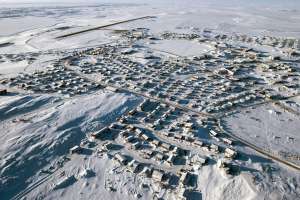
Located on the northwestern shore of Hudson Bay in the Canadian territory of Nunavut, this hamlet of about 3,000 sits just below the Arctic Circle. Its climate is definitely what one would associate with Canada’s Arctic region: Outdoor temperatures stay below freezing from late September to early June. There are no trees because the climate has too few warm days for them to grow — even though some days in July and August can exceed 60 degrees Fahrenheit.
As a result of its location, Rankin Inlet sits on permafrost. It’s possible to dig into the ground and lay pipes, but the liquids within them will freeze if the pipes are not insulated. This’s why buildings in Rankin Inlet are connected to a “utilidor,” a heavily insulated underground tunnel system that contains both water and wastewater systems.
Rankin Inlet’s utilidor was installed in the 1970s and has deteriorated over the decades due to the rigors of the hamlet’s harsh climate. The community has experienced a variety of problems including cross-contamination between potable water and wastewater in access vault manholes, groundwater seeping into the utilidor’s wet wells, inadequate water pressure due to tuberculation and overcapacity within pumping systems. There was also frost damage to some of the concrete access vaults, settling of sewer lines due to changes in the permafrost, and some pipe joint failures.
This is why the Government of Nunavut hired Dillon Consulting to devise systemwide upgrades, including increased water flows, to the utilidor in 2021. The company was so successful in its efforts that it won the 2024 Award of Merit from the Northwest Territories and Nunavut Association of Professional Engineers and Geoscientists, and the 2024 Award of Excellence from the Association of Consulting Engineering Companies Canada.
Beyond the cold
Rankin Inlet’s climate is a major obstacle for any company working on the utilidor. It’s not just a matter of the weather: The short summer and long winter means that outdoor work can only be done for four months a year (July-October) at most.
Then there’s the issue of logistics. Due to its isolated location, there are no highways or railroads coming into Rankin Inlet. Although air links do exist, when it comes to the bulk materials needed to repair the utilidor, these have to be brought by ship via “sealifts,” says Alexander Williams, a civil engineer and partner at Dillon Consulting. “Due to these logistical challenges, a typical project that would take six months in the South — from start to finish with engineering, execution and construction — can take up to two years in the North.”

Thorough prep
Mindful of the uniqueness of the Rankin Inlet utilidor replacement project, Dillon Consulting was very thorough in scoping out its requirements. Their preparations included LIDAR scans and Matterport-style 360-degree scans of the pump houses to compensate for the lack of existing plans. This work supported using AI-enabled 3D walkthroughs afterward. “As a result, when we got to the design stage, we had all the information that we required,” Williams says.
Using this and other data, Dillon Consulting drew up a comprehensive evaluation and risk assessment of the utilidor. This allowed them to determine which repairs and upgrades were needed to address short-term issues and support long-term expansion plans.
“One of the biggest issues being faced by the utilidor was the reduction in capacity,” says Williams. “We dealt with that in two phases. The first phase, which was immediate, dealt with some pump replacements and emergency repairs. The second phase addressed higher-risk issues of potential contamination within the Williams Lake pump house and getting them resolved.”
In addition to this work, Dillon Consulting replaced the utilidor’s below-grade pumps and wet wells with an at-grade system using a “break tank” and vertical turbine pumps within the system’s existing building footprint. This fix reduced the risk of contamination while increasing capacity/pressure for Rankin Inlet’s new airport terminal. Upgrading the supply pumps at Nipissar Lake also boosted the utilidor’s water capacity while adding system redundancy.
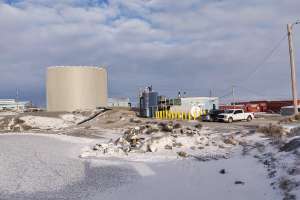
Other improvements included increasing the thickness of the insulation protecting the underground pipes, adding transition couplings outside the access vaults to reduce leaks, and replacing iron pipes inside the vaults with stainless steel to reduce tuberculation.
The company also designed and deployed innovative partitioned water/sewer manholes to prevent cross-contamination of water flows with the utilidor, making design improvements to its water mains to minimize heat loss, tuberculation and the settling of pipes into the permafrost. Finally, in a smart money-and-logistics saving move, Dillon Consulting refurbished the utilidor’s steel manholes in place rather than replacing them with new ones.
All of these improvements had to be tied into aged pipes while continuing to use an obsolete programmable logic controller system to manage the utilidor.
“The PLC was so old that we couldn’t get parts for it anymore,” Williams says. “So we had to utilize the existing system as best as we could while putting in a separate panel for the pumps, and then tying it all together at the end. This meant that a lot of the existing sensors had to be fed through that old-style system.”
Careful coordination
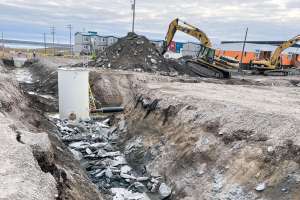
The logistical and weather constraints that Dillon Consulting faced during the utilidor upgrade project necessitated perfect project planning. If a piece of necessary heavy equipment broke down, or if someone forgot to order enough concrete, company staff couldn’t just jump on the phone and have it sent in overnight. Everything that was required had to be anticipated, procured and shipped well in advance — because once the sealift had left port, that ship had definitely sailed.
This is why Dillon Consulting managed the project using extensive financial projections and life cycle analyses. They figured out up front what the optimal timelines and supply chain decisions were, while factoring in the risks that went with a limited contractor base, sky-high material transport costs and the need to coordinate their efforts in tune with the region’s Inuit community.
All told, the utilidor upgrade project was a substantial challenge for Dillon Consulting, and one that they rose up to meet head-on. Today, in the cold of yet another Canadian Arctic winter, the residents of Rankin Inlet are enjoying the benefits of Dillon Consulting’s hard work — in a region where reliable freshwater and sewage service are invaluable commodities.