Ted J. Rulseh | Published on 3/10/2026
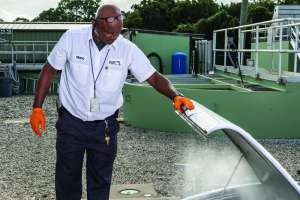
The Holiday Pines Water Reclamation Facility is a model of resilience and teamwork.
Its high performance earned it a 2024 Operations Excellence Award from the Florida Department of Environmental Protection for resource stewardship and public health protection.
The plant, in St. Lucie County, Florida, operates as one facility but is essentially two plants in one. The original plant, built in 1990, was upgraded in 2012 to deliver reclaimed water to the nearby Island Pines Golf Course.
In 2024, the facility underwent a major expansion, boosting its design capacity to 0.6 mgd. It now treats an average of 0.1 gpd, serving about 4,000 customers in the Holiday Pines Subdivision and surrounding communities. Its strength lies not just in the infrastructure but in the people and values behind its operation.
Holiday Pines’ reputation for tight process control begins in the lab, overseen by Manolito Sewel, senior lead plant operator and 2016 Operator of the Year, recognized by the Florida Water and Pollution Control Operators Association.
He’s supported by Terrance Williams, lead operator; Scott Riggins, compliance officer; and Blaze McBride, trainee. The team also includes county maintenance technicians Gary Bawgus, Todd Brown, Dwayne Callender, Brendan Cummins, Alvin Daniels, Brayan Hurtado, David Lero, Daniel Duarte, James Snell and Jean Raphael.
“Our core value is to protect the environment,” says Sewel, “That’s the No. 1 priority at all of our county’s facilities.”
Ownership transition
St. Lucie County, on Florida’s east coast north of Palm Beach, acquired the Holiday Pines plant in 1999 from the private Holiday Pines Service Corp. The plant was run by contract operators until the county assumed control about five years ago. The county operates five other water reclamation facilities:
- South Hutchinson Island, 1.6 mgd design, 300,000 gpd
- North Hutchinson Island, 0.8 mgd design, 200,000 gpd
- Lakewood Park, 20,000 gpd design
- Fairwinds Golf Course, 40,000 gpd design
- Fairgrounds, 16,000 gpd average
Sewel has been at the Holiday Pines plant for the past 18 years. The old and new plants use similar activated sludge processes. Influent (all domestic and light commercial flow) enters an on-site lift station that pumps it up to a Hydroscreen static screen (Parkson Corporation). The flow then passes through a splitter box into the aeration tanks.
The newer treatment train has three aeration basins in series; the older train has two. Oxygen is introduced by surface spray aerators (ABB Baldor-Reliance). The entire flow proceeds to three secondary clarifiers followed by three rotating disc filters (two from WesTech Engineering, one from Veolia). After chlorine disinfection, pumps deliver the final effluent to a holding pond on the golf course.
Sludge is pumped to a holding tank; contractor Synagro dewaters the material in a centrifuge (Centrisys/CNP) and hauls the cake to a CompostUSA site.
Keeping tabs
Sewel takes pride in the plant’s process control. “Every morning around the same time, we pull a sample from the effluent part of the aeration basin,” he says. “We take it to our on-site lab and run a series of tests: 30-minute settleometer, pH, nitrate, ammonia, total phosphorus, mixed-liquor suspended solids.
“We calibrate our desktop meters to standards and buffers, and from there we calibrate our inline meters, if needed, to make sure our numbers are correct.” The inline meters measure final effluent for pH, chlorine and turbidity. “If anything is off a little bit, we’ll make small adjustments or wait until the next day to see how the process is going.”
One challenge is keeping the aeration levels in both trains within the correct range, Riggins observes: “Each plant is run differently. It’s a little tricky to keep the total nitrogen and total phosphorus down, as well as the TSS. We have to keep the air dialed in.”
Samples for compliance purposes are sent to a PACE Analytical certified lab or, for emergency or other time-sensitive tests, to a Eurofins Scientific lab nearer to the plant.
The plant is staffed weekdays from 7 a.m. to 3:30 p.m. A SCADA system (VTScada by Trihedral) provides monitoring and automated control. “We have an alarm system so that if the effluent pH or chlorine gets too low, or if the NTU gets too high, an autodialer calls us out,” says Sewel.
A tight ship
The staff’s meticulous care extends beyond the treatment process. “One thing we do really well here is housekeeping,” Sewel says. “The upkeep, the painting, the mowing of the grass.”
The operators are fully cross-trained. Sewel holds Class B Wastewater Operator and Class C Drinking Water licenses; Williams holds Class B Wastewater; and Riggins holds Class B Water and Wastewater. Riggins has passed both water and wastewater state Class A exams and is earning hours toward his licenses.
“We have good communication,” says Sewel. “We all just get along. We respect each other.” Riggins adds, “If somebody has a problem, we work with each other and help out any way we can. It’s all a team effort.”
Williams credits the county leadership for supporting the facility: “Our administration is top-notch. They give us a job and expect us to do it. If we need something, if a pump goes down, they’re quick to assess and repair it and get the plant up and operating correctly.”
In the end, it’s all about producing high-quality reuse water. “The water and wastewater operators in St. Lucie County stick to our core values,” says Sewel. “We make sure that our effluent is protective of public health. We do all we can to stay in compliance.”