Market Summary
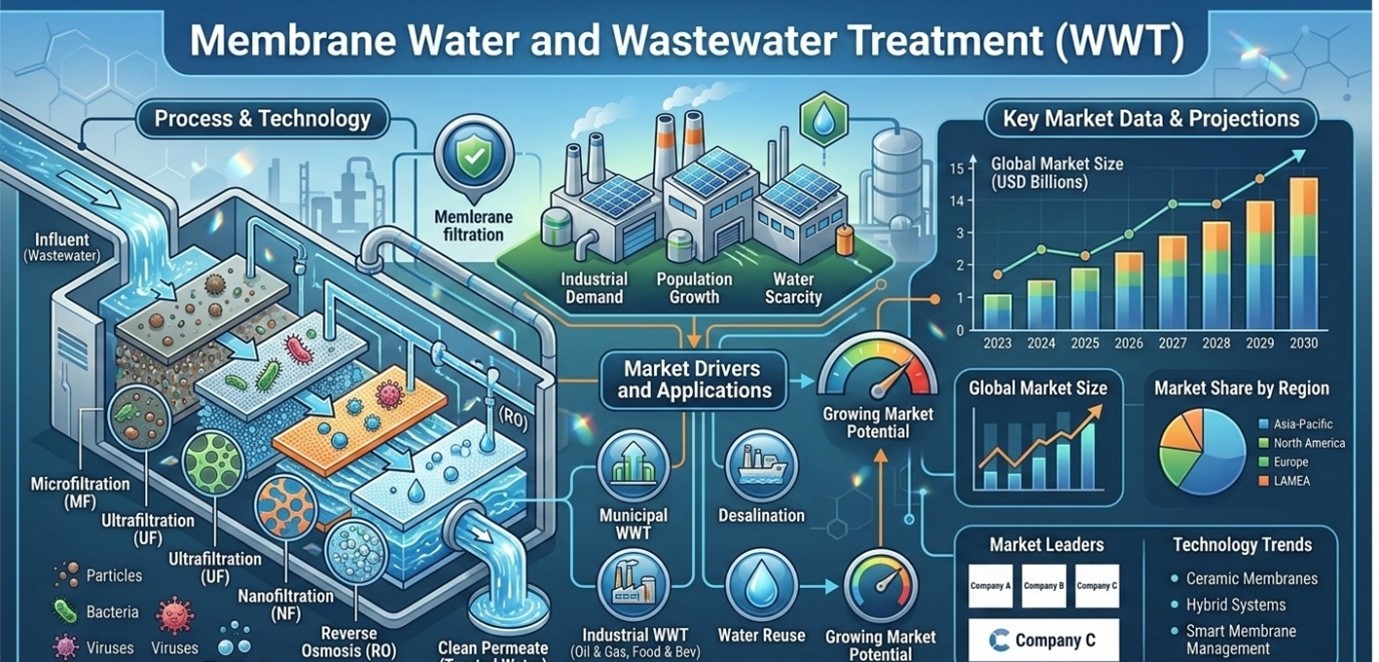
According to our Growth Market Report, the global membrane water and wastewater treatment (WWT) market size reached USD 16.2 billion in 2024, demonstrating robust momentum driven by increasing environmental regulations and rising demand for clean water. The market is projected to grow at a CAGR of 7.8% from 2025 to 2033, with the total value expected to reach USD 32.2 billion by 2033. This sustained growth is primarily fueled by advancements in membrane technology, rapid urbanization, and the pressing need for efficient water management solutions across municipal, industrial, and residential sectors.
Introduction: The Growing Importance Of Advanced Water Treatment
Water is one of the most critical resources for human survival, industry, and economic growth. However, increasing urbanization, industrial discharge, and population growth are putting immense pressure on global water resources. Traditional water treatment methods are often insufficient to handle modern contaminants.
Membrane Water and Wastewater Treatment (WWT) technologies have emerged as a highly efficient and reliable solution. These advanced filtration systems are capable of removing microscopic pollutants, pathogens, and dissolved solids, ensuring safe and reusable water. As water scarcity intensifies worldwide, membrane-based treatment systems are gaining significant momentum in global water management strategies.
Understanding Membrane Water And Wastewater Treatment Technology
Membrane water treatment is a filtration process that separates contaminants from water using semi-permeable membranes. These membranes allow water molecules to pass through while blocking unwanted particles, chemicals, and microorganisms.
Unlike conventional treatment systems, membrane technologies provide high precision filtration and operate with minimal chemical usage. This makes them environmentally friendly and highly efficient.
Membrane treatment systems are widely used in municipal water treatment plants, industrial wastewater treatment facilities, desalination plants, and water reuse projects. Their versatility and performance make them a cornerstone of modern water purification infrastructure.
Key Types Of Membrane Technologies
Microfiltration (MF)
Microfiltration membranes remove suspended solids, bacteria, and some protozoa. These systems are commonly used as pre-treatment steps in water purification plants and in industries where particulate removal is required.
Ultrafiltration (UF)
Ultrafiltration membranes provide finer filtration compared to microfiltration. They remove viruses, bacteria, and macromolecules. UF technology is widely used in drinking water treatment and wastewater recycling projects.
Nanofiltration (NF)
Nanofiltration membranes target dissolved organic compounds and certain salts. These systems are often used for water softening and selective contaminant removal.
Reverse Osmosis (RO)
Reverse osmosis is the most advanced membrane filtration technology. It removes dissolved salts, heavy metals, and microscopic pollutants. RO systems are extensively used in desalination plants and high-purity water production.
Rising Demand For Water Reuse And Recycling
One of the strongest drivers of the membrane WWT market is the growing global demand for water reuse. Industries and municipalities are increasingly adopting wastewater recycling programs to conserve freshwater resources.
Membrane systems play a crucial role in enabling safe water reuse. These technologies can treat wastewater to a level where it becomes suitable for industrial processes, irrigation, and even potable applications.
Countries facing water stress are investing heavily in advanced wastewater treatment infrastructure. As a result, membrane technologies are becoming central to sustainable water management frameworks worldwide.
Industrial Sector Driving Market Growth
Industrial wastewater contains complex contaminants including chemicals, oils, heavy metals, and organic pollutants. Conventional treatment methods often struggle to remove these substances efficiently.
Membrane-based treatment systems offer high-performance solutions for industries such as:
- Power generation
- Pharmaceuticals
- Food and beverage
- Oil and gas
- Semiconductor manufacturing
These industries require high-quality water for production processes and must comply with strict environmental regulations. Membrane technologies provide reliable treatment while reducing environmental impact.
Increasing Environmental Regulations
Governments across the world, particularly in the United States and Europe, are enforcing strict wastewater discharge standards. Industries must treat their wastewater before releasing it into natural water bodies.
Membrane filtration systems help organizations meet these regulatory requirements by ensuring high levels of contaminant removal. Their ability to consistently deliver treated water that meets environmental standards makes them a preferred solution for modern treatment plants.
Environmental agencies are also promoting water reuse initiatives, further strengthening the adoption of membrane treatment technologies.
Advancements in Membrane Materials and Design
Technological innovations are playing a crucial role in the growth of the membrane WWT market. Researchers and manufacturers are developing advanced membrane materials that offer improved durability, efficiency, and resistance to fouling.
Some notable innovations include:
- Graphene-based membranes for enhanced filtration efficiency
- Anti-fouling coatings that reduce maintenance requirements
- Energy-efficient membrane modules
- Smart monitoring systems integrated with treatment plants
These advancements are helping water utilities and industries reduce operational costs while improving treatment performance.
Municipal Water Treatment Expanding Opportunities
Municipalities around the world are facing increasing pressure to provide safe drinking water and effective wastewater treatment services to growing populations.
Membrane technologies are increasingly being integrated into municipal water treatment infrastructure due to their compact design and superior filtration capabilities. Compared to conventional treatment systems, membrane plants require less space and can handle variable water quality conditions more effectively.
Urban regions with aging infrastructure are also upgrading their treatment facilities, creating strong demand for advanced membrane solutions.
Desalination Projects Supporting Market Expansion
Desalination has become a vital solution for countries experiencing severe freshwater shortages. Reverse osmosis membrane technology is at the core of most desalination plants worldwide.
Large-scale desalination projects are being developed in regions such as the Middle East, Australia, and parts of the United States. These projects rely heavily on high-performance membrane filtration systems.
As climate change and population growth increase water demand, desalination investments are expected to accelerate, contributing significantly to the growth of the membrane WWT market.
Challenges Affecting Market Adoption
Despite its advantages, membrane water treatment technology faces certain challenges.
Membrane fouling remains one of the primary operational issues. Fouling occurs when contaminants accumulate on the membrane surface, reducing filtration efficiency and increasing maintenance requirements.
Additionally, the initial installation cost of membrane systems can be higher compared to conventional treatment methods. However, long-term benefits such as reduced chemical consumption, improved water quality, and lower operational costs often outweigh these initial expenses.
Continuous research and development efforts are addressing these challenges by introducing more durable and cost-effective membrane materials.
Competitive Landscape
- SUEZ Water Technologies & Solutions
- Veolia Water Technologies
- Pentair plc
- Evoqua Water Technologies
- Toray Industries, Inc.
- Koch Separation Solutions
- Mitsubishi Chemical Corporation
- DuPont Water Solutions
- Hydranautics (Nitto Denko Corporation)
- Pall Corporation
- GE Water & Process Technologies
- LG Chem
- LANXESS AG
- Asahi Kasei Corporation
- Membranium (RM Nanotech)
- H2O Innovation
- Aquatech International LLC
- Parker Hannifin Corporation
- Synder Filtration, Inc.
- Microdyn-Nadir GmbH
Future Outlook: A Critical Role In Global Water Security
According to our Growth Market Report, the future of the membrane water and wastewater treatment market looks highly promising. As water scarcity becomes a global concern, governments, industries, and municipalities are increasingly prioritizing sustainable water management solutions.
Membrane technologies offer unmatched efficiency, scalability, and reliability in water purification. Their ability to support water reuse, desalination, and industrial wastewater treatment positions them as a critical component of future water infrastructure.
With ongoing technological advancements and increasing investments in water treatment projects worldwide, membrane-based treatment systems are expected to play a central role in ensuring global water security.