
Disinfection has been a pillar of water treatment for more than 100 years. While chlorine is known for being one of the first disinfectants for public water treatment, there is now a range of technologies that can effectively protect drinking water systems and receiving waters, particularly ultraviolet (UV) light and ozone. While these technologies are sometimes viewed as competitors, they are increasingly used together for pathogen and chemical control. Understanding the value of each technology and how they can work in concert to provide a multi-barrier solution is critical when designing a disinfection system.
Chlorine: Defense In Distribution
Chlorine is the most established disinfection technology for two main reasons: cost-effectiveness and its ability to provide a stable, long-lasting residual. The latter is essential for drinking water systems, as it ensures water remains treated throughout the distribution system. It’s versatile, can be generated onsite, or converted to gas or liquid, depending on the plant’s needs.
However, these advantages come with environmental and safety considerations. Rigorous safety protocols are required when handling chlorine in liquid or gas form. In addition, chlorine reactions can form disinfection byproducts (DBPs), which is a major concern in waters with high total organic carbon (TOC) levels. To protect sensitive ecosystems, state and local regulations often require dechlorination at wastewater treatment plants before discharge, adding cost and operational complexity. And while chlorine is a powerful disinfectant, it is less effective against certain microorganisms, such as Mycobacterium, Cryptosporidium, and Legionella.
UV: Compact, Clean, And Efficient
For chlorine-resistant organisms, UV disinfection offers a highly efficient alternative that produces no harmful DBPs and remains nontoxic to aquatic life. With minimal physical footprint, UV systems can be retrofitted into existing structures, making them a cost-effective choice for facilities with limited space. However, UV lacks a disinfection residual. While this means it can’t protect against bacterial regrowth in distribution pipes, it makes the technology ideal in wastewater systems that are otherwise required to dechlorinate. Additionally, it is an effective disinfection solution for drinking water facilities that have concerns with Cryptosporidium and/or DBP formation potential.
When working with UV systems, water quality parameters, including transmittance, solids, and dissolved heavy metals, can impact efficiency and effectiveness. Maintenance is also a consideration, as UV lamps, quartz sleeves, and wiper rings require regular cleaning and/or replacement.
Ozone: The Versatile Powerhouse
Ozone is a highly effective disinfectant, however, for utilities facing broader water quality challenges. Ozone offers capabilities beyond disinfection, including the removal of taste and odor compounds (such as 2-methylisoborneol and geosmin), reducing color, and oxidizing heavy metals like iron and manganese. Ozone is also considered one of the most powerful tools for managing harmful algal blooms. Modern ozone systems are highly automated, with minimal daily consumables and robust safety measures. The flexibility of ozone allows it to be applied at various points in the treatment train, either as a pre-oxidant or as an intermediate step to make organics easier to remove with downstream (bio)filters.
When evaluating ozone systems, plant managers and engineers should consider their high capital costs and large infrastructure footprint (see Table 1). Ozone also has a short half-life, making it effective in wastewater, reuse applications, or any system that requires only short contact times for disinfection. However, it cannot replace chlorine in applications where long contact times and residual are critical. Furthermore, if the source water contains high levels of bromide, operators must manage bromate formation.
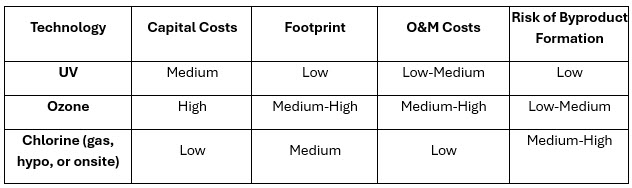
Table 1. Considerations for retrofitting/upgrading disinfection technologies into a water treatment train. (Note: This is a general comparison; many variables can impact final cost and footprint.)
Layered Defenses For Modern Water Challenges
Although each of these technologies is effective at standard disinfection, their different characteristics and modes of action can be most beneficial when used in combination. While ozone and chlorine are most effective for viruses and bacteria, UV irradiation can inactivate most pathogens, including spores. In addition, ozonation, often applied in combination with biological filtration, can reduce formation of disinfection byproducts in downstream chlorination or enhance efficiency of UV disinfection by increasing UV transmittance. A common strategy involves using ozone and/or UV as the primary disinfection process to handle tough pathogens, followed by a small dose of chlorine for distribution residual. In some industrial settings, UV is even used for ozone destruction to remove any remaining chemical residual before the water moves to its final application.
Advanced treatment trains for potable reuse applications often combine a series of various disinfection methods to provide a high level of safety for human consumption. While ozonation combined with biologically active activated carbon (BAC) filtration is often applied as the first chemical and pathogen barrier after tertiary filtration, UV disinfection or UV advanced oxidation (combination of high-dose UV irradiation with free chlorine or H2O2 to remove pathogens and chemicals) provides the last barrier before the addition of free chlorine provides a residual to prevent regrowth.
Ultimately, the choice between chlorine, UV, and ozone is less about selecting a single winner and more about designing a multi-barrier strategy tailored to specific water challenges. While chlorine remains the indispensable guardian of distribution pipes, UV and ozone provide the heavy lifting required to neutralize more complex contaminants and pathogens. More importantly, as regulations tighten and water scarcity drives the push for potable reuse, the combination of these technologies will become increasingly important in forming safe and effective treatment trains.