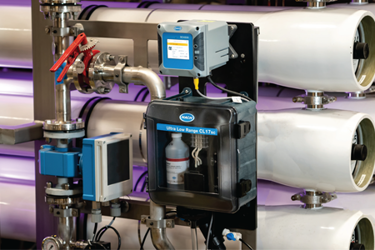
Membrane manufacturers usually put forth warranty requirements based on expected free chlorine presence in the RO feedwater, because these species are most harmful for the membranes. However, other oxidants may harm the membranes and adversely affect the produced water quality. We need to remember that dechlorination may use either sulfite-based chemicals (e.g. SBS) or GAC and may or may not be followed by RO filtration. Here are the main points to compare the value of Total vs Free chlorine monitoring:
- When there are only free chlorine species in the sample, the total chlorine method shows the same chlorine concentration as free chlorine method and therefore provides the same value. The results can be recorded/reported as Cl2 and it will satisfy the RO membrane warranty requirements.
- Effectively, total chlorine method measures TRO = Total Residual Oxidant which is accepted for regulatory reporting e.g. by IMO for Marine applications. Total chlorine DPD method measures all chlorine species as well as other strong oxidants that may be potentially harmful for the RO membrane and/or the product when TRO (e.g. chloramines) are present in produced water, e.g. after GAC dechlorination w/o RO filtration.
- When free chlorine DPD method is used in the presence of other oxidants, the readings may be misleading due to the interference (cross-sensitivity) and chlorine residual may be overestimated. For instance, if total chlorine DPD method shows 30 ppb, there should be enough oxidants in the water to keep bio-growth under control. When free chlorine DPD method shows 30 ppb, that does not necessarily mean that it is free chlorine present at that concentration, it may be the interference caused by manganese or chloramines in the water.
- Free chlorine DPD method cannot measure single ppb chlorine concentrations with necessary accuracy, due to the nature of the method and the analyte. However, total chlorine DPD method can provide accurate results in the ultra-low chlorine range, whether there is only free chlorine, or other oxidants present.
- Stability of the total chlorine reagents is significantly better to endure on-instrument life for longer than 1 month without loss of accuracy and that suits the intermittent RO skid operation much better.